News

A Combined Approach Using Lorentzian Fitting and ANNs for…

Modeling techniques are crucial in designing microwave devices and help to gain a comprehensive understanding of their operation. In recent years, artificial neural networks (ANNs) have proven successful in modeling the frequency-dependent behavior of various microwave devices such as antennas, sensors, and transistors. ANNs are capable of learning from device behavior through a defined training process and can be used as a fast and accurate model for the description of the device under test. In addition to ANN modeling, the Lorentzian fitting procedure is often used to accurately determine the resonant parameters of microwave resonators. The accurate determination of the resonant frequency and quality factor is desirable regardless of the type of resonator or its application (e.g., filter, sensor). Literature reports suggest that the most accurate estimation of these resonant parameters is obtained by measuring the scattering parameters of the device under test using a vector network analyzer (VNA), followed by fitting a Lorentzian function. This approach compensates for resonator non-idealities, which may affect the accurate determination of both resonant frequency and Q-factor.

In a recent study, the University of Messina (Italy), in collaboration with the University of Niš (Serbia), has developed a new and more reliable modeling tool for studying microwave resonators by combining the Lorentzian fitting method and the ANN-based modeling approach. This approach combines the benefits of both methods and has been successfully applied to model a microwave sensor for relative humidity measurements.

The research, which was co-authored by Prof. Zlatica Marinković from the University of Niš, Dr. Giovanni Gugliandolo, Prof. Giuseppe Campobello, Prof. Giovanni Crupi, and Prof. Nicola Donato (Res4Net member) from the University of Messina, was presented at the 2022 IEEE International Conference on Metrology for eXended Reality, Artificial Intelligence, and Neural Engineering (IEEE MetroXRAINE 2022) and was recognized with the “Best Paper Presented by a Young Researcher” award.

For a more detailed description of the research, please refer to the conference proceeding webpage.

News

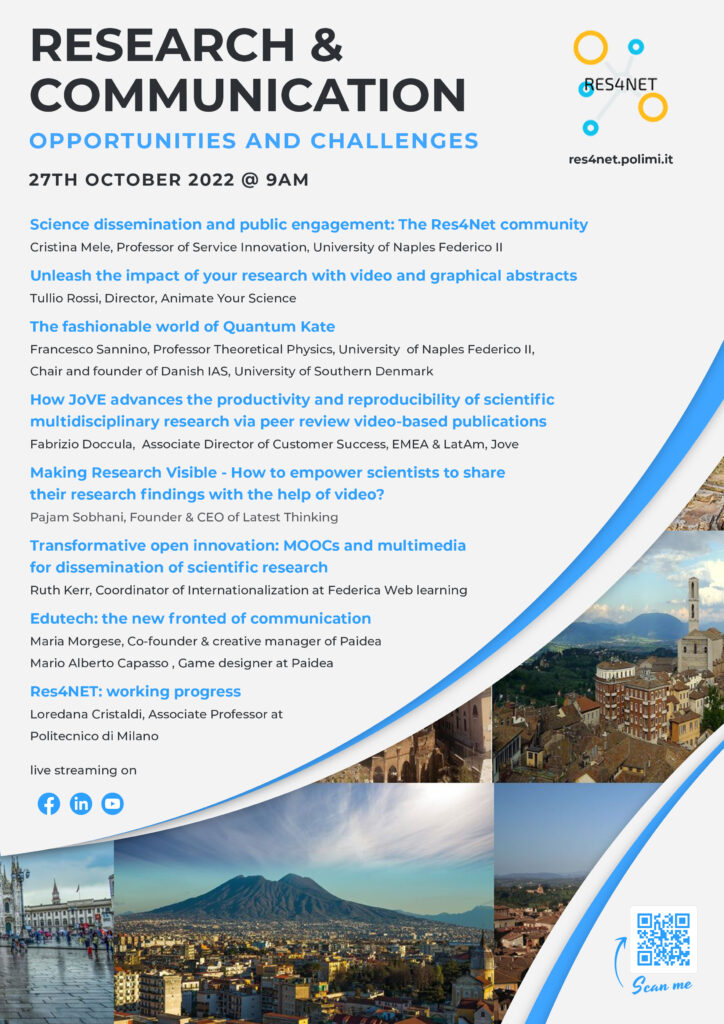
Science and communication: the Res4Net experience

Today disciplinary knowledge is fragmented from one another because years and years of sectoral study has led to making each discipline independent.

Everything stems from the crisis that occurred after the Second World War both at a political-economic and cultural level. The goals achieved in all fields ushered in an era of crisis. Society, in an era that was perceived as advanced compared to the modern one, found itself in a climate of insecurity, indifference and the fall of ideals and traditions. Society is in constant motion governed by technological progress which imposes new adaptations every time and leaves behind those who fail to adapt. And it is in this climate that the term “post-modern” is introduced into cultural debates, defining it as something not completely definitive and stable. With the typical urgency of the postmodern age to make the disciplinary fields autonomous and independent, the result of the scientific-cultural and institutional developments of modernity, it has made specialist scientific research necessary and interdisciplinary research almost useless.

The knowledge thus described, however, fails to give an adequate explanation to the phenomena that are studied as the communication between the different disciplines is almost nil due to a forced division and a lack of communication between them. The problem is the language used within each discipline: a specific and technical language functional only to it. The aim that is achieved is a progress of the discipline concerned with scientific rigor, but prevents dialogue with the other areas, which in turn follow the same internal codification. The result is, therefore, an internal coherence, but problematic with the outside. Scientific communication, therefore, must be interdisciplinary to define and contextualize the object of study in reality using a clear language shared by all the disciplines involved in the research and must be transdisciplinary to expand scientific knowledge to a meta-disciplinary level that opens up to the different dimensions of reality through a simple and understandable language also for public opinion in order to legitimize the motivation, the methodological and technological choices and the purpose of the research proposed for the purpose to promote science as a common good necessary for everyone’s life.

In a globalized world, the scientist advertises his work from the beginning, in progress and at the end for two fundamental reasons: to spread scientific knowledge to share and legitimize his work and to seek funding to sponsor his research in order to participate in the construction of a common good, scientific knowledge. Here a paradox emerges: science understood as a common good is forced to promote itself in order to survive in the market of funded projects.

In Italy, for example, the situation is currently fragmented and without any coordination due to the lack of a common data sharing policy. Laws and decrees have regulated state funding for research and education, always resulting insufficient to meet the needs of the scientific world which, where possible, relied on private funding. Even today, scientists and the academic world are asking for more resources to invest in the research needed for new emerging phenomena.

Beyond the choice of strategies, techniques or channels to be used for the dissemination of scientific knowledge or, simply, scientific communication, it is necessary to remember that the information transmitted must have constructive and educational foundations in order to guarantee true emancipation of society because science must be a continuous discovery that helps to resolve and enrich emerging issues by building knowledge that becomes a common good and as such must convey security to those who read and internalize it.

The dissemination of science must become the heritage of everyone, but above all of the new generations.

The Res4Net laboratory network is a concrete example of this new reality in which the main Italian universities and research centers adhere. It proposes itself as a group to think, practice and promote the new scientific communication with particular attention to collaboration and interdisciplinary integration. Members are offered support services for the development of multimedia products and guidance on the effective use of new media. A space on dedicated blogs and social channels is also offered. Res4Net promotes seminars and public debates to stimulate reflection on the theme of new forms of scientific communication. I had the opportunity and the fortune to participate in the realization of this project as an intern at the Politecnico di Milano. My contribution was to offer consultancy on the communicative and digital aspects and the creation of some multimedia materials to be published online on the platform and on the social media involved. My collaboration began in October of the previous year and ended at the end of the academic year. As a person who is growing professionally in the world of communication, I have been able to verify and witness the results of the changes inherent in the ways, times and research objects of today’s science. A sector which, through initiatives such as Res4net, is changing the face of discovery and the goals that man can and must achieve. The involvement of non-experts in the era of globalization is a must and requires an effort of openness and comparison with scientists. The new communication, if used in compliance with the values and social rules that characterize civil societies, can become an invaluable tool for comparison, interdisciplinarity, collaboration and culture.

The greatest result of this project is that it has made the enthusiasm for discovery, interdisciplinarity, collaboration and comparison between experts and not a style of work and life. The process is still in its infancy, the tools and methods of scientific dissemination are still being tested: the communication strategies and the models to be inspired by are constantly changing and, therefore, a constant object of study. The aspiration is to approach a real dialogue. Scientists and the public participate equally in discussions and debates on science and technology topics which can be conducted in different dissemination forms, such as conferences and public forums. A first step has already been taken. On October 27 Res4net participated in the IEEE MetroXRAINE 2022 conference where it was presented and it was possible to compare with other projects in the field of communication. It was possible to observe and learn from those who know more than us.

The results achieved to date are those expected, but certainly in the climate and working style proposed by the Res4net project, the goals to be achieved, even at an international level, will not be long in coming.

In recent months, posts have been published on the site and on social media maintaining common characteristics. Simple texts have been used in the use of semantics and syntax. The terminology used, in fact, is that specific to the sector, but can also be used by less experienced users. The language used is always English to facilitate the international dissemination of information. The choice of layout, images and videos has been studied so that it is captivating and exhaustive to capture the user’s curiosity.

The Res4Net project was born a little over two years ago and is at the beginning of its journey which is in continuous evolution and relationship with the new social and scientific needs that are highlighted in the succession of the passage of time. The universities and research centers involved observe, experiment and verify ever new hypotheses to solve or improve man’s lifestyle.

News

A new dataset of satellite images for deep learning-based…

Methodology: The usage of coastline data published in scientific projects is explored for the generation of a dataset of labelled satellite images for sea-land segmentation/coastline detection tasks. Sentinel-2 Level-1C images are considered for the dataset. The Sentinel-2 mission provides high-resolution satellite images with 13 spectral bands [2]. Four bands have spatial resolution of 10 m, six bands have resolution of 20 m, and three bands have resolution of 60 m. All continental land and coastal waters up to 20 km from the shore are covered by the mission, with a revisit time of 5 days.

The coastline data used for labelling satellite images is taken from the NOAA Continually Updated Shoreline Product (CUSP) project [3]. This dataset contains the coastline of the USA and is continually updated. The coastline is split in short segments annotated with additional information such as the date and type (e.g., satellite or aerial) of data used for the coastline extraction and the type of coast. Given the availability of these additional information and the high resolution of coastlines, this dataset has been chosen for our work.

CUSP data must be filtered to obtain valid samples for the task at hand. Coastline of Alaska are excluded, since it contains regions covered by ice (we focus on exposed land). Only observations made later than December 2016 are considered, (Sentinel-2 Level-1C products availability). Only the following types of coasts are considered (CUSP nomenclature):

“Man-made.Rip Rap” +  “Natural.Great Lake Or Lake Or Pond” + “Natural.Mean High Water”

Excluded types of coasts were e.g., rivers and jetties, that would have led to images containing most of the Sentinel-2 pixels of a single class.

The Sentinel-2 tiles containing the selected coastline segments has been identified by querying the PEPS CNES platform. Only results of the query characterized by a cloud cover lesser than 3% are considered, and, among them, that with the nearest date to the observation date of the segment are chosen. The maximum allowed temporal distance between the segment date and the Sentinel tile date was set to 30 days. At the end of the procedure, 155 Sentinel tiles were selected.

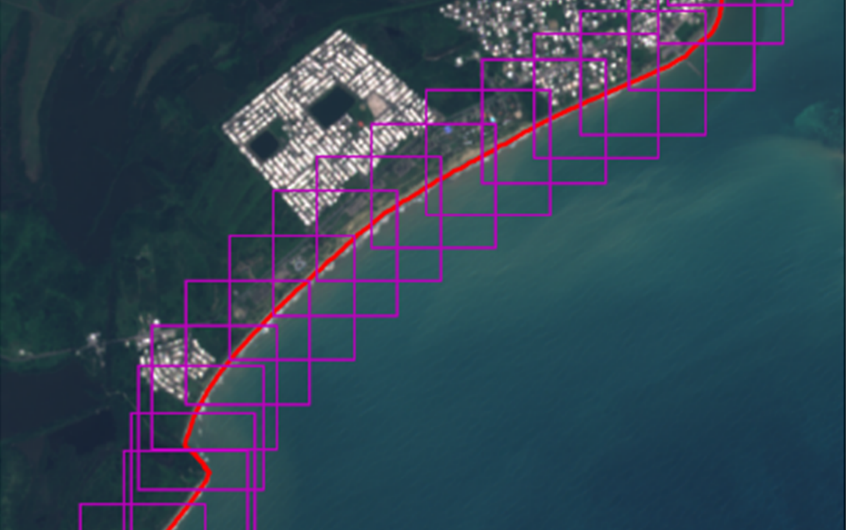
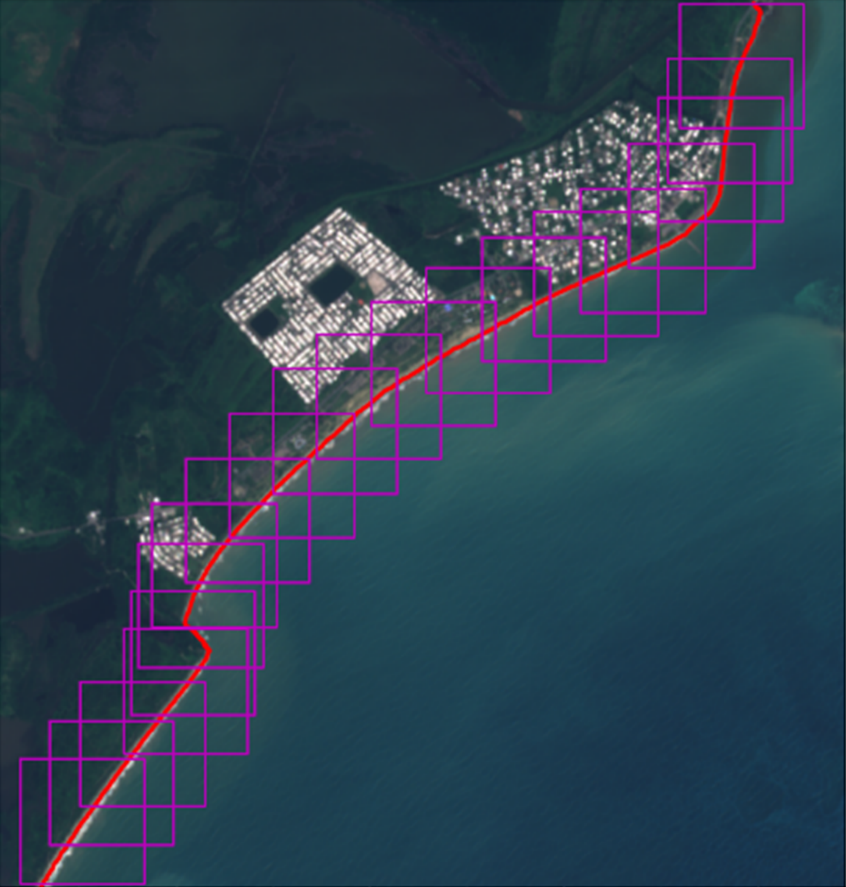
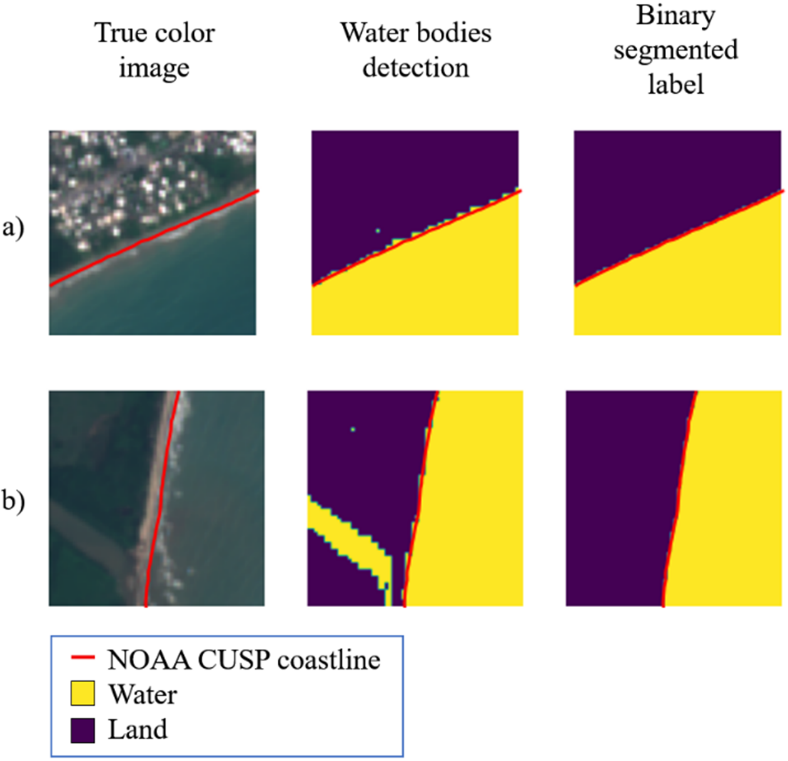
The coastline segments are projected to the ortho-images plane, and 64×64 squared tiles are extracted following the coastline. The position of the extracted tiles is chosen so that the coastline intersects each tile in two points, and 50% of overlap between consecutive tiles was used to maximize the quantity of unique pixels in the dataset (see Fig. 1). Each extracted tile is further processed to create the relative binary segmented label. CUSP provides only the coastline and gives no information which of the two regions defined by the coastline is sea or land. The water bodies detection based on the band 2/band 11 ratio is used for this purpose. Besides, tiles with at least 90% of pixels detected as water on one side, and at least 90% of pixels as non-water on the other side are labelled; the other are discarded. This method implies a verification of CUSP data (Fig. 2).

Conclusions: The presented method proved to be effectively usable for generating datasets of labelled satellite images. Its clear advantage is that it allows reusing high-quality coastline data created by experts, to label satellite images of different types (multispectral images, SAR images) and acquired from different sources. The effectiveness of the method has been successfully demonstrated using NOAA CUSP coastline data and Sentinel-2 multispectral images, but the procedure can be replicated using other coastline data and satellite images.

References:

[1] M. Scarpetta, M. Spadavecchia, V. I. D’Alessandro, L. D. Palma and N. Giaquinto, “A new dataset of satellite images for deep learning-based coastline measurement,” 2022 IEEE International Conference on Metrology for Extended Reality, Artificial Intelligence and Neural Engineering (MetroXRAINE), 2022, pp. 635-640, doi: 10.1109/MetroXRAINE54828.2022.9967574.

[2] https://sentinel.esa.int/web/sentinel/missions/sentinel-2

[3] https://shoreline.noaa.gov/data/datasheets/cusp.html

Fig. 1 - Extraction of tiles following the coastline. The true color image included in Sentinel-2 Level-1C products is depicted in the figure for clarity.
Fig. 2 - Examples of labelling. A) Correctly labelled tile. B) Discarded tile. A river or canal not included in the NOAA CUSP coastline is correctly identified by the water bodies detection.
News

IEEE International WORKSHOP ON METROLOGY FOR THE SEA, Milazzo…

On Oct. 3-5, 2022, the 2022 IEEE International Workshop on Metrology for the Sea (MetroSea 2022) was held at Milazzo Castle (Milazzo, Messina, Italy). It was organized by the University of Messina with the active support of the three general chairs: Prof. Pasquale Daponte from the University of Sannio, Prof. Nicola Donato (Res4Net member), and Prof. Giovanni Randazzo, both from the University of Messina.

The workshop was also sponsored by the Italian Navy and by the Italian Coast Guard, the presence of the vessels “Vega” (Italian Navy) and “Diciotti” (Italian Coast Guard) during the three days was an outstanding contribution to the program activities.

The workshop was attended by researchers from universities worldwide and experts in the field, in such a context the special session “Military Metrology for the Sea” was organized by AFCEA Naples Chapter with the active participation of Italian Navy research centers such as the Hydrographic Institute of the Navy (IIM), the Naval Support and Experimentation Center (CSSN) and the Joint Forces Center for Military Studies and Applications (CISAM).

During the conference, the plenary session witnessed the participation of Dr. Laura Giuliano, Director of Science, CIESM – Mediterranean Science Commission, with a presentation entitled “Measuring Marine Life – across (and beyond) paradigms”, Prof. Franc Dimc, from the Faculty of Maritime Studies and Transport University of Ljubljana, with a speech on “Observations of vessels and human actions at Port of Koper approach”, and Prof. Aimé Lay-Ekuakille from University of Salento, with a presentation entitled “The EU BAT constraints on the measurement systems for industrial wastewater treatments: quality and quantity for discharging into the sea”.

In light of the international resonance and high scientific level of the workshop, the Italian Navy granted the presence of Vessel Vega, on which the first day of the workshop was concluded with the welcome dinner.

The high level of participation at MetroSea2022 enabled researchers and scientists at the international level to discuss each other on their research activities in the field of metrology applied to the sea. These discussions represent moments of mutual exchange, knowledge, and personal growth.

Authors of papers presented at this conference are invited to submit a technically extended version to one of the following Special Issues:

  1. Selected Papers from the 2022 IEEE International Workshop on Metrology for Sea in JMSE“, edited by Dr. Roberto Carlucci (University of Bari) and Dr. Christoph Waldmann (University of Bremen). Deadline for manuscript submissions: 15 December 2022. 
  2. Remote Sensing and Other Geomatics Techniques for Marine Applications“, edited by Prof. Dr. Claudio Parente (University of Naples Parthenope) and Prof. Dr. Salvatore Gaglione (University of Naples Parthenope). Deadline for manuscript submissions: 20 February 2023.
  3. Selected Papers from the 2022 IEEE International Workshop on Metrology for the Sea“, edited by Prof. Nicola Donato (University of Messina) and Dr. Giovanni Gugliandolo (University of Messina), both Res4Net members. Deadline for manuscript submissions: 31 May 2023. 

The next IEEE International Workshop on Metrology for the Sea (MetroSea2023) will be held in Valletta (Malta) in 2023.

News

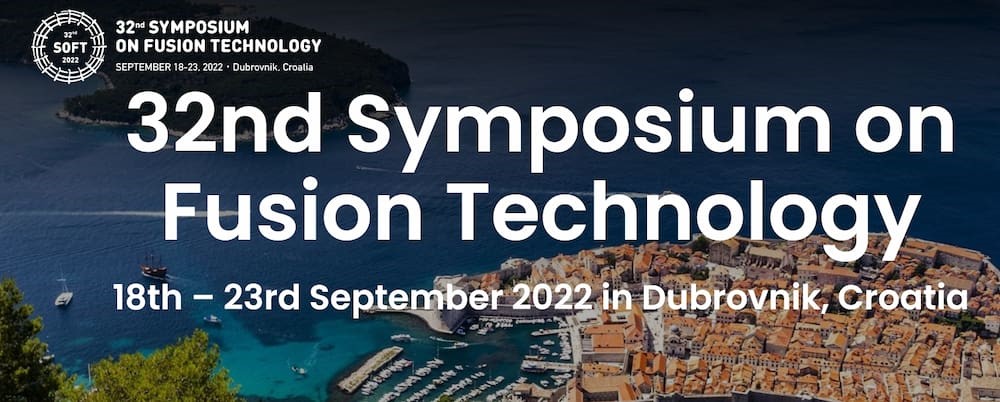
32nd SOFT Conference 2022 18-23 September Dubrovnik (Croatia)

On 18-23 September 2022 the Croatian city of Dubrovnik provided a magnificent setting for the 32nd Symposium on Fusion Technology (SOFT 2022), the most prestigious conference in this field in Europe with a thousand world leaders from science and industry, and important personalities in the fusion research from all over the world, who discussed the most important innovations in the field of nuclear fusion. In this context, the University of Tuscia was present at the event with 6 PhD students, who presented their research activities during poster sessions over the 6 days.

During the conference the participants had the possibility to listen interesting talks of several key fusion experts as Alain Becoulet (Engineering Domain Head of ITER Organization), Pietro Barabaschi (new Director-General of ITER), Francesco Romanelli (Chairman of the BoD of DTT s.c.a.r.l.), Gianfranco Federici (head of EUROfusion technology department) and Tom Barret (technical leader of CHIMERA project, UKAEA).  “It was so nice to sit around the table again with colleagues and discuss in the hallways the things that really matter, that make us want to work together, and that help us move things forward,” said Dr Tony Donné, Programme Manager of the EUROfusion Consortium, whose presentation on “Navigating along the fusion roadmap” was the most viewed online. During the days of the conference, participants had the pleasure of visiting the magnificent old town of Dubrovnik, set of the famous TV series “Game of Throne”.

From University of Tuscia different topics are exposed during the poster sessions. Six posters were presented. Below the main arguments are reported.

The first topic concerns the sacrificial limiters used inside nuclear fusion machine. Three different posters are relative to them.

Towards the demonstration of fusion energy, the greatest challenges may arise from the need of strongly mitigating the degradation of conventional breeding blanket first wall modules during plasma transients and disruptions. Within the EUROfusion DEMO research activities, first wall limiters are envisaged as the last protection resource of the otherwise un-shadowed rector wall. In this context, optimized layouts of the plasma-facing units of such components were developed, equipped with innovative tungsten metamaterials as sacrificial armours able to meet the conflicting requirements of the limiters. Additive manufacturing was successfully employed to produce lattice samples for material characterization and testing, currently ongoing.

The second work concerns the development of a parametric model to identify the optimized component configurations to be considered for the sacrificial limiter, in order to maximize its functional effectiveness, by scanning all possible combinations of relevant parameters. The identification of possible configurations was followed by a preliminary study through Computational Fluid Dynamics of the thermo-hydraulic behaviour of the plasma-facing-component cooling circuit, satisfying the total pressure drop requirement for its potential integration.

The third work concerns the development of a 3D finite element model to analyse in depth the influence of the actual features of latticed metamaterial on the overall performance of the DEMO limiter, based on a flat tile configuration. Its main goal is to identify the most promising layout as pre-conceptual design for the fabrication of a small-scale mock-up. The model allowed to perform coupled thermos-mechanical analyses with regard to the loading conditions that develop during different plasma scenarios and allowed to verify structural integrity of the component through acceptance criteria established for ITER in-vessel components.

The fourth work presents a disruptions database analysis aimed at characterizing off-normal plasma scenarios in ST40 2021-2022 experimental campaign. In this context, to support the Spherical Tokamak ST40 operations, effects associated with disruptions have been investigated. To define a safe operational space, disruption numerical simulations have been performed with the aim to reconstruct the plasma dynamic behaviours by using MAXFEA for a better calibration of the code, starting from experimental data.

The fifth work aims to define the structural behaviour of ST40 Inner Vacuum Chamber (IVC2) under the action of electromagnetic loads. The analysis was carried out considering the entire ST40 mesh model with high degree of detail allowing to accurately approximate its real behaviour. The completeness of the model has guaranteed to study the global ST40 stress state with a focus on the local stress state generated on the IVC2 and on all the components that weigh on it.

The last work deals with the verification of the structural integrity of the Divertor Tokamak Test (DTT) vacuum vessel against loads associated to several machine operating states. A large campaign of thermo-structural analyses has been carried out on a very detailed FE model of the vessel to assess the actual design and to improve it where needed. The stresses over the vessel comply with the limits suggested by the principle standards.


News

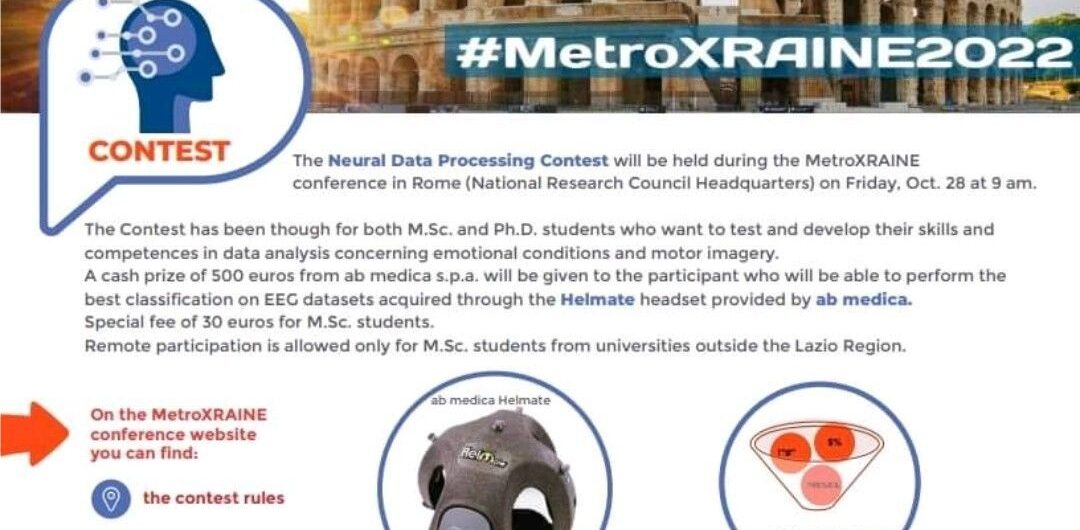
Join to Neural Data Processing Contest during MetroXRAINE conference!

The Neural Data Processing Contest wiil be held during the MetroXRAINE conference in Rome (National Research Council Headquarters) on Friday, Oct. 28 at 9 a.m. The contest has been though for both MSc and PhD students who want to test and develop their skills and competences in data analysis concerning emotional conditions and motor imagery. A cash prize of 500 euros from ab medica s.p.a. will be given to the participant who will be able to perform the best classification on EEG datasets acquired through the Helmate headset provided by ab medica spa
Special fee of 30 euros for M.Sc. Student. Remote participation is allowed only for M.Sc. students from universities outside the Lazio Region.
On the MetroXRAINE conference website you can find: • the contest rules (https://lnkd.in/gBn__HCd) • the registration form (https://lnkd.in/gzcYNrkk) • the datasets to train your classifiers (https://lnkd.in/g6rszUip)
 
News

FuseNet PhD Event 2022 4-6 July Padova (Italy)

On 4th-6th July, the FuseNet PhD Event 2022 took place in Padua, Italy. 131 PhD students coming from 23 countries and 44 different institutes and universities, including the University of Tuscia in Viterbo, participated and animated the FuseNet PhD Event 2022. After two years, it finally took place in a live format again, in the amazing venues of University and Orto Botanico of Padua. The event was hosted by the University of Padua and Consorzio RFX and it was the place where European fusion PhD students meet and interact with affirmed international researchers in the field of Nuclear Fusion, aiming to strengthen and expand the fusion research network.
University of Tuscia was present at the event with 8 PhD students, who presented their research activities during poster sessions over the 3 days.
During three days, participants had the possibility to listen interesting talks of different important personalities in the fusion research as: Elena Righi (Head of Unit Euratom, European Commission), Piero Martin (professor at University of Padova), Elena de la Luna (researcher at LNF CIEMAT), Simone Peruzzo (Head of Technology and Engineering at Consorzio RFX), Gianluigi Serianni (researcher at Neutral Beam Test Facility), and Chiara Bustreo (project leader of the EUROfusion Socio Economic Studies). Three guided tours were organized to explore some important places of Padova: Palazzo Bo, Orto Botanico and Consorzio RFX. Furthermore, different oral sessions and poster sessions animated the days and permitted the students to know a lot about different topics related to the Nuclear Fusion world. To conclude social dinners entertained participants.
Different topics were exposed during the poster sessions from University of Tuscia. A brief presentation is reported.

  • A work concerning the conceptual design of the mirrors of the multi beam transmission line of the Electron Cyclotron Heating system of the Divertor Tokamak Test Facility (DTT) was presented. In particular different coupled thermal and structural finite element (FE) simulations were carried out to study some first proposals of mirror design, comparing different structures and materials.
  • A work concerning thermo-structural coupled analyses of the DTT vacuum vessel in multiple machine operating states was presented. The design was verified against the principle nuclear standards and design changes have been proposed according to the results of such verifications.
  • A work concerning the conceptual design of the vacuum system for DTT was presented, focusing on three main sub-systems: divertor, vacuum vessel and cryostat. In particular the systems operations were explained, and estimations of regeneration and evacuation times were carried out and a first layout shown.
  • A work concerning the Spherical Tokamak ST40, owned by Tokamak Energy Ltd, was presented. In particular the definition of the structural behaviour of the ST40 Inner Vacuum Chamber under the action of electromagnetic loads from plasma fast “upper vertical displacement event” scenario was investigated. The considered loads were obtained from the electromagnetic analysis of the device and interpolated on the structural model. Indeed, the study represents the final phase of the proposed procedure, and it verifies the compatibility for non-conventional low aspect ratio tokamaks.
  • A work concerning the structural assessment of tokamak components under thermal and electro-magnetic loads emerging during normal and off-normal operations (e.g., plasma disruptions) was presented. An approach aimed at 3D detailed evaluation of the electro-magnetic loads experienced by the tokamak structures both in normal and off-normal conditions was proposed, developed and successfully applied to DEMO, DTT and ST40.
  • A work concerning the description of the neutral model in the GBS simulation code was presented. The simulations are able to reproduce neutral-plasma interactions in the 3D turbulent fluid simulations made with GBS. They show the first simulations obtained with neutrals in a TCV-like scenario, a study of the density shoulder formation, along with the latest work made to simulate also the molecular neutral dynamics.

Finally, a work about the first wall sacrificial limiters inside the vacuum vessel that represents the last protection resource to prevent the reactor wall from excessive damage was presented. The integration of W-lattices in the architecture of such components can allow to meet their conflictual requirements: through a prompt vapour shielding formation, these can ensure effective thermal decoupling between plasma and heat sink during disruptions and provide effective exhaust of the nominal thermal load during stationary operation.

News

Microwave Transducers for Gas Sensing: A Challenging and Promising…

The research of new typologies of gas sensors with improved detection performance has resulted in a wide adoption of gas sensors in different fields. The technology development has led to the introduction of low-cost, compact gas sensors with improved performance in detection process. The major purposes of gas detection are environmental monitoring, human health monitoring and industrial plant safety. Today, environmental monitoring is a subject of utmost importance. A substantial amount of airborne pollution, which has a negative influence on both public health and the climate, is a hallmark of the economic prosperity of contemporary society. The need for the development of gas sensors used in the detection of harmful chemicals such nitrogen oxides, sulfur dioxide, carbon monoxide, ozone, and benzene has become more pressing as a result of today’s pervasive and persistent atmospheric pollution. Additionally, concerns with public health are brought on by atmospheric pollution in metropolitan areas, rural areas, and even inside houses.

Moreover, gas sensors are employed in medical applications. As an example, oxygen sensors are used in the oxygen therapy, while ammonia sensors have been employed to identify chronic renal illness. Finally, gas sensors are frequently used in industrial environment, including hazardous emissions monitoring, chemical detection in the production of plastics, and in the chain of food production and storing.

Commercial gas sensors typically use conductometric transducers because they have a long lifespan, great resolution (at the ppm level), and are relatively inexpensive. Due to the alluring benefits of this technology, interest in research on gas detection using microwave transducers has increased in the last years. Since microwave gas sensors may operate at room temperature, less power is needed to manage them. Moreover, they are characterized by a fast response time.

In such a context, the University of Messina has contributed to researching novel microwave transducers for sensing applications. In particular, the research group held by Prof. Donato (University of Messina, Res4Net member) has proposed several configurations of microwave gas sensors.

A brief review of the latest advances in the development of microwave transducers for gas sensing can be found here

News

Localization and characterization of cable faults with tdr and…

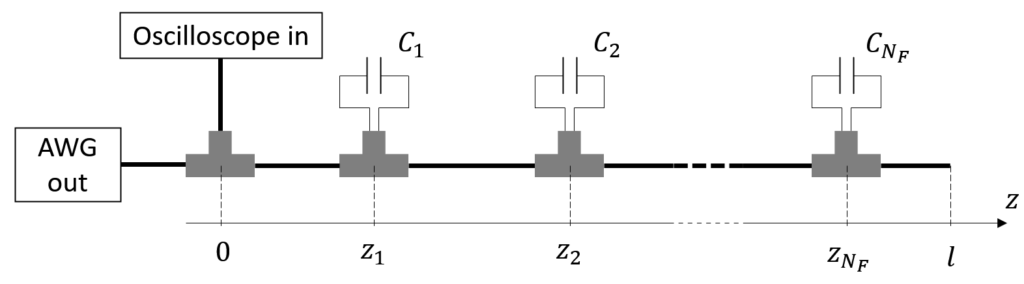
Methodology: The situation considered is represented in Fig. 1. The cable has total length  and contains  localized faults, simulated by means of capacitors connected in parallel by means of T-junctions. The capacitors are placed at a distance  from the beginning of the cable and have capacitance . The stimulus signal is generated by an Agilent 33250A AWG, while the TDR signals are acquired using a LeCroy Waverunner-2 LT262 oscilloscope. A Gaussian pulse is used as the stimulus signal.

The neural network employed was inspired by single-shot CNNs (YOLOs) for object detection. These neural networks consist of a sequence of convolutional and pooling layers. Since in the present case signals are processed in the time domain, 1D convolutional layers are used, rather than 2D ones, as the basic component of the model. The input of the first layer is the measured TDR signal, the output of the last layer is an  matrix ( is number of cells into which the length of the line is divided), which identifies position, class, impedance and probability of the fault.

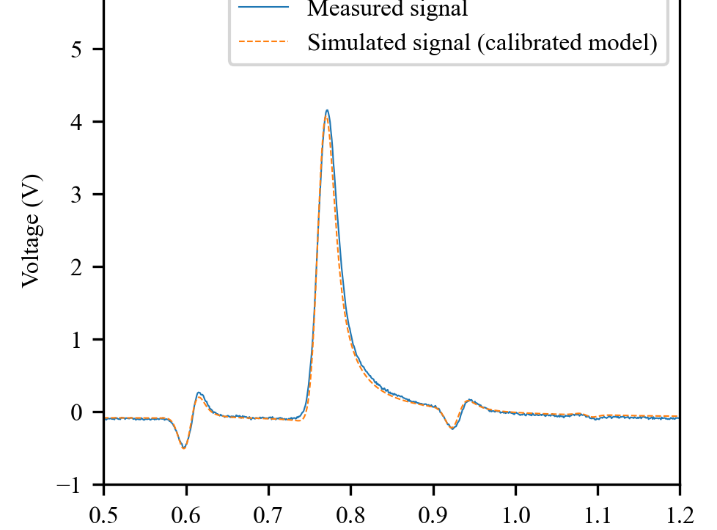
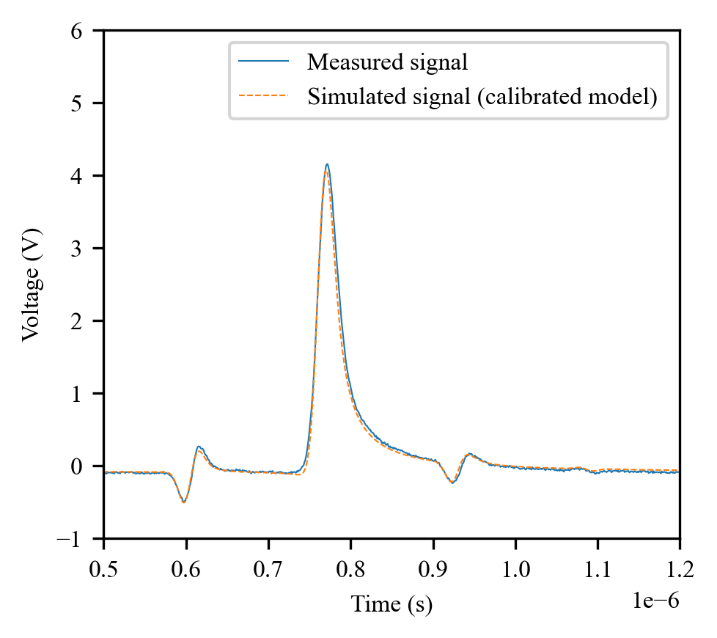
The training set of the neural network is obtained by generating simulated reflectograms under various fault conditions. The simulator uses the primary RCGL parameters of the line, which were identified using the stepped-frequency waveform reflectometry (SFWR) developed in [3]. This technique can be used easily for long cables and using low-cost, portable instrumentation. The identification obtained is quite accurate, as shown in Fig. 2.

Results: Tables I and II summarize some of the results obtained. In particular, Table I reports some results obtained on cables with four capacitive faults and shows the remarkable accuracy with which they are localized. The quantification may appear less accurate; however, it must be said that the capacities reported are simply nominal capacities of the capacitors used to simulate the fault. These capacities have quite high tolerances per se and are not related to the frequency range of the TDR signal used in the test. Table II reports statistics on the overall measurement errors in all the experiments conducted (six with a single failure, six with two failures, two with three failures, two with four failures), in terms of RMS error and mean absolute percentage error (MAPE).

Conclusions: The experiments showed that the proposed method is remarkably accurate, as well as being very general. It can be applied to the localization and characterization not only of faults in cables, but also of points of discontinuity in distributed sensitive elements.

References:

[1] Scarpetta, M.; Spadavecchia, M.; Adamo, F.; Ragolia, M.A.; Giaquinto, N. Detection and Characterization of Multiple Discontinuities in Cables with Time-Domain Reflectometry and Convolutional Neural Networks. Sensors 2021, 21, 8032. doi: 10.3390/s21238032 .

[2] M. Scarpetta, M. Spadavecchia, G. Andria, M. A. Ragolia and N. Giaquinto, “Analysis of TDR Signals with Convolutional Neural Networks,” 2021 IEEE International Instrumentation and Measurement Technology Conference (I2MTC), 2021, pp. 1-6, doi: 10.1109/I2MTC50364.2021.9460009.

[3] N. Giaquinto, M. Scarpetta and M. Spadavecchia, “Algorithms for Locating and Characterizing Cable Faults via Stepped-Frequency Waveform Reflectometry,” in IEEE Transactions on Instrumentation and Measurement, vol. 69, no. 9, pp. 7271-7280, Sept. 2020, doi: 10.1109/TIM.2020.2974110..


Table I. Estimation results for real cables with four capacitive faults.


Experiment 1

Experiment 2


Nominal

Estimated

Nominal

Estimated

Length of the cable (m)

143

142.96

143

142.96

Position of fault 1 (m)

50

49.87

50

49.88

Position of fault 2 (m)

65

65.12

65

65.03

Position of fault 3 (m)

115

114.93

115

114.95

Position of fault 4 (m)

131

131.40

131

131.32

Capacity of fault 1 (pF)

107

117

107

115

Capacity of fault 2 (pF)

217

214

152

165

Capacity of fault 3 (pF)

404

436

309

323

Capacity of fault 4 (pF)

450

441

450

439


Table II. Estimation errors obtained for experimental signals.

Cable length error

Fault position error

Fault capacity error


RMSE (m)

MAPE

RMSE (m)

MAPE

RMSE (pF)

MAPE


0.12

0.10%

0.13

0.22%

14

4.3%

Fig. 1 - Representation of the measurement setup. The TDR is applied to a cable with NF faults, to estimate the NF pairs of values zi, Ci.
Fig. 2 - An experimental TDR signal compared with a simulated signal obtained using the calibrated model of the coaxial cable. The cable was 66 m-long with a parallel capacitive fault of 47 pF at 50 m. The first reflected signal is due to the fault while the second one is due to the cable’s open termination.