 Uncategorized
Enhancing ABP Estimation through Comprehensive PPG Signal Analysis and…
Enhancing ABP Estimation through Comprehensive PPG Signal Analysis and Advanced Loss Function Optimization
Background: Blood pressure (BP) is a fundamental physiological parameter for the diagnosis and management of cardiovascular diseases, particularly hypertension. Conventional cuff-based measurement techniques provide only intermittent values and are not suitable for continuous monitoring. Photoplethysmography (PPG) has emerged as a promising non-invasive technique for continuous BP monitoring, especially in wearable devices and telemedicine applications. However, accurate arterial blood pressure (ABP) estimation from PPG signals remains challenging due to noise, motion artifacts, and strong inter-subject variability. Deep Learning (DL) models offer powerful tools to capture the complex nonlinear relationship between PPG and ABP signals, but their performance is strongly influenced by the choice of the loss function.
Objectives: The main objective of this study is to enhance the accuracy and clinical relevance of ABP estimation from PPG signals by introducing a dedicated loss function that incorporates physiological knowledge. Specifically, the study aims to:
- develop DL-based regression models for ABP estimation using raw PPG signals;
- design a novel loss function that emphasizes systolic and diastolic peaks of the ABP waveform;
- evaluate the proposed approach in an inter-subject framework to assess its robustness and generalization capability.
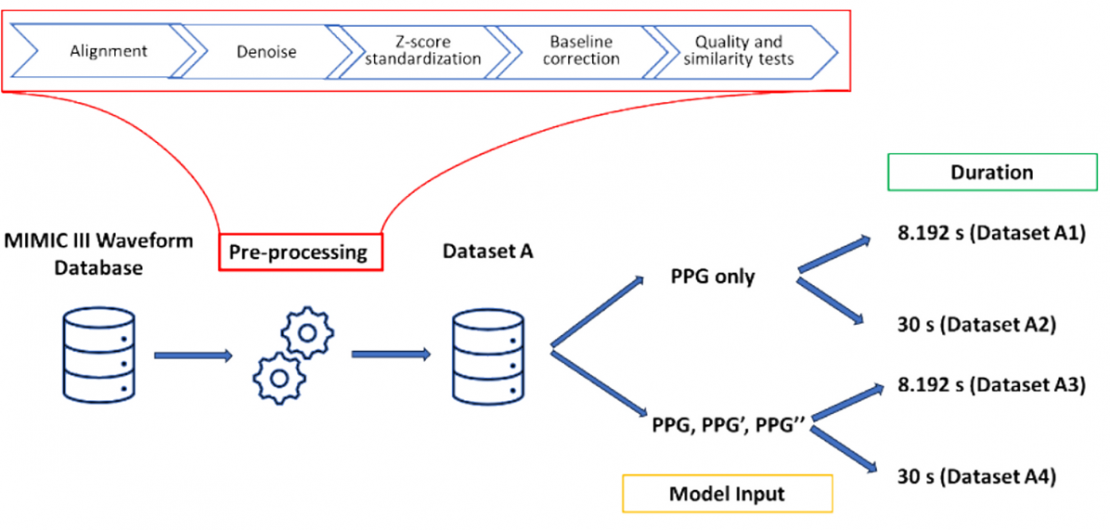
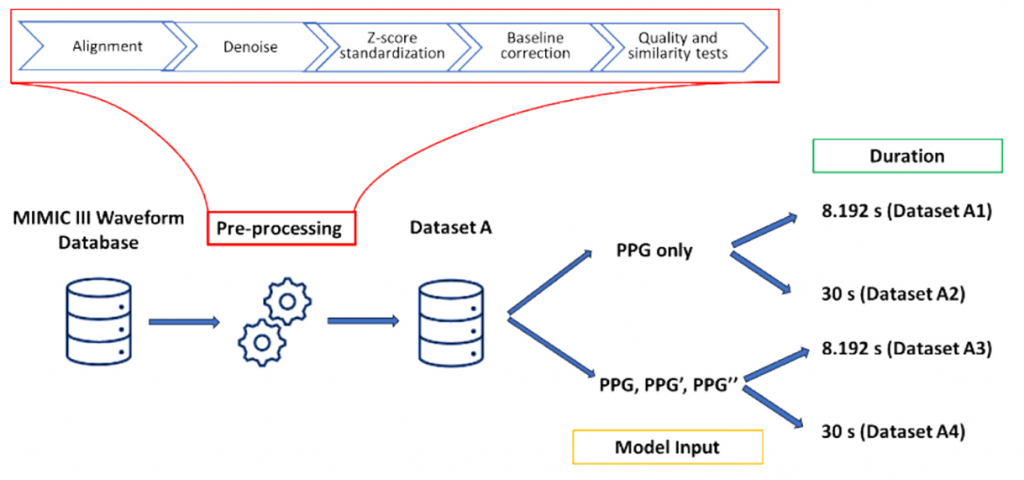
Methods: The proposed methodology is based on data extracted from the MIMIC-III waveform database, which contains synchronized PPG and ABP signals acquired from intensive care unit patients. After subject selection, signals were preprocessed through temporal alignment, noise reduction, normalization, and quality assessment. The overall preprocessing and dataset construction workflow is summarized in Figure 1.
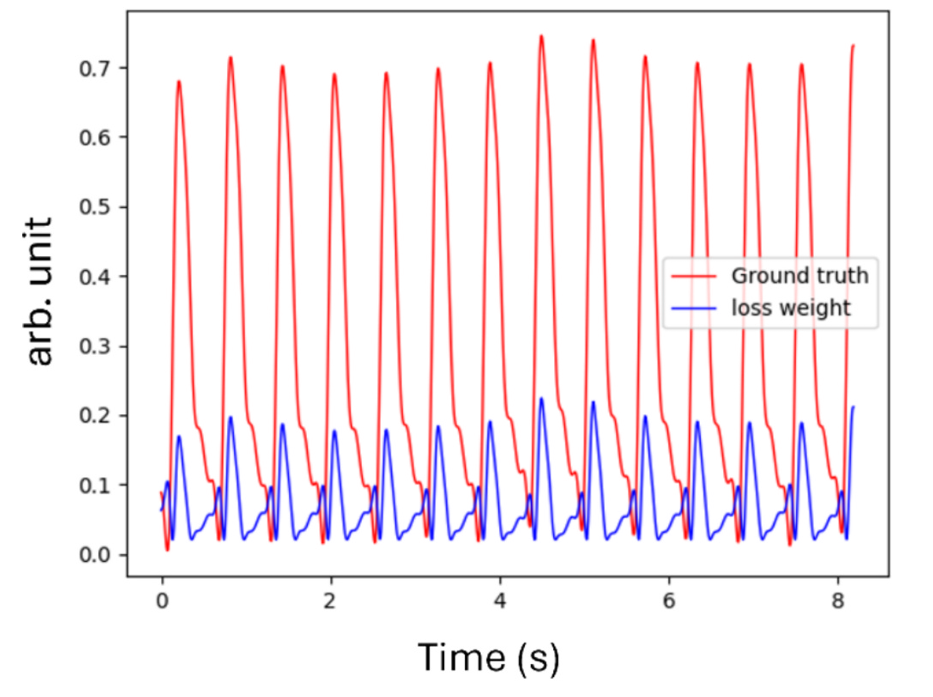
Several DL architectures were implemented, including Residual U-Net and Long Short-Term Memory (LSTM) networks adapted for one-dimensional signal regression. Models were trained using the Adam optimizer and evaluated using mean absolute error and root mean squared error metrics. To improve prediction accuracy at clinically relevant points, the proposed Peak Enhancing Loss Function (PELF) was introduced. The loss function assigns higher weights to systolic and diastolic points of the ABP waveform, as illustrated by the weighting profile in Fig. 2, thus guiding the model toward more accurate peak reconstruction.
Results: The performance of the proposed Peak Enhancing Loss Function (PELF) was quantitatively evaluated and compared with the conventional Mean Squared Error (MSE) loss using a Residual U-Net architecture. The comparison was carried out on the test set considering two different signal durations, 8.192 s (Dataset A3) and 30 s (Dataset A4), using PPG signals and their derivatives.
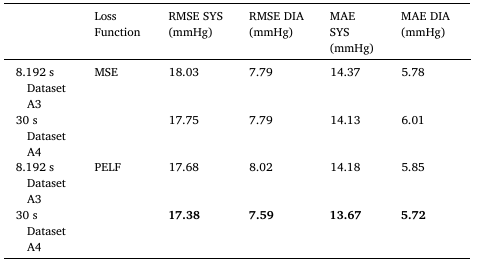
The results reported in Table 1 show that the adoption of PELF leads to an overall improvement in BP estimation accuracy with respect to MSE. In particular, for the 30 s signal configuration (Dataset A4), PELF achieves the best performance, with a reduction of both RMSE and MAE for systolic and diastolic pressure estimation. Specifically, the RMSE for systolic pressure decreases from 17.75 mmHg (MSE) to 17.38 mmHg (PELF), while the MAE for systolic pressure is reduced from 14.13 mmHg to 13.67 mmHg. A similar improvement is observed for diastolic pressure, where the MAE decreases from 6.01 mmHg to 5.72 mmHg. For the 8.192 s configuration (Dataset A3), PELF provides slightly improved systolic error metrics and marginal variations in diastolic RMSE compared to the use of MSE. These results indicate that the proposed loss function is particularly effective when longer signal segments are available, allowing the model to better exploit temporal information.
Conclusions: This study highlights the importance of loss function optimization in DL–based non-invasive BP estimation. By integrating physiological knowledge into the training process, the proposed approach improves the accuracy and reliability of ABP predictions from PPG signals, supporting the development of cuffless BP monitoring systems suitable for telemedicine and continuous health monitoring applications.
References:
[1] Luisa De Palma, Gregorio Andria, Filippo Attivissimo, Anna Maria Lucia Lanzolla, Attilio Di Nisio, Enhancing ABP estimation through comprehensive PPG signal analysis and advanced loss function optimization, Measurement, Volume 256, Part B, 2025, 118210, ISSN 0263-2241, https://doi.org/10.1016/j.measurement.2025.118210.